
Innovative Lighting Solutions for Remote Work Success
Elevate your remote work with innovative office lighting solutions that enhance productivity and comfort in your home office setup.

28 min read
Nearly 90% of remote workers say their home office lighting affects productivity and moodyet most still work under a single overhead bulb. That gap is an opportunity: the right mix of innovative office lighting can transform a cramped corner into a focused, comfortable workspace that supports long hours and clear video calls.
Good home office lighting blends ambient, task, and accent layers to match how you work. Practical task fixtures like swing-arm desk lamps and adjustable floor lamps provide focused illumination close to the work surface, while ceiling-mounted pendants or wall sconces free up floor space and improve room flow. Natural light remains the gold standard for clarity on camera and wellbeing, but well-placed LED strips and bias lighting can fill gaps without glare.
Leading brands show how technology and design meet remote needs. Systems from companies such as LEDVANCE and LBX Lighting support tunable white, wireless control, and energy savings, while smaller makers like Color Cord Company prove that style and budget can coexist in purpose-built fixtures. Smart controls let you set scenes for focus, meetings, and breaks, making lighting for remote work both efficient and adaptable.
For practical tips and examples to start upgrading your setup, see a concise guide to layered and task lighting at home office lighting ideas. Simple changesadding dimmers, choosing the right color temperatures, and positioning fixtures to reduce screen reflectionsare among the best lighting solutions for enhancing remote workspace comfort and performance.
Key Takeaways
- Layered lightingambient, task, and accentcreates a flexible, productive environment.
- Use adjustable task lights and ceiling or wall fixtures to free desk and floor space.
- Natural light is ideal; supplement with LEDs and bias lighting to avoid glare.
- Tunable white and smart controls improve comfort, energy use, and video presence.
- Select stable, dimmable fixtures and place lights to reduce screen reflections.
Why lighting matters for remote work and home office productivity
Good lighting for remote work changes how a home office feels and how people perform. Natural light makes a workspace inviting and helps sustain focus. Facing a window brightens the face for video meetings and can cut the effort needed to look alert on camera.
Impact of light on focus, mood, and circadian rhythm
Light affects alertness through the impact of light on focus and mood. Morning exposure to cool, bright light signals the brain to wake up. Evening warm tones ease the body toward rest. Products like LEDVANCE BIOLUX HCL show how circadian lighting that shifts from warm to cool and back supports regular sleepwake patterns.
Research-backed benefits: reduced eye strain and improved performance
Studies link well-designed lighting to measures of performance and comfort. Proper illuminance and glare control help reduce eye strain and increase concentration. Dynamic LED systems and tunable fixtures improve ambiance while saving energy, making it easier to maintain healthy light levels throughout the day.
How lighting influences video call presence and professional image
Professional on-camera lighting can make small differences look polished on video. A neutral, front-facing fill light softens shadows and keeps skin tones natural. Warm indoor bulbs in the 22002700 K range can mimic flattering sunlight for cameras during evening calls. These adjustments improve how colleagues perceive you and help sustain engagement during long meetings.
Principles of effective home office lighting for comfort and performance
Good lighting starts with planning. Aim for home office comfort by blending layers of light, picking high-quality sources and placing fixtures to reduce screen glare. Thoughtful choices make work easier on your eyes and help camera-ready appearance during meetings.
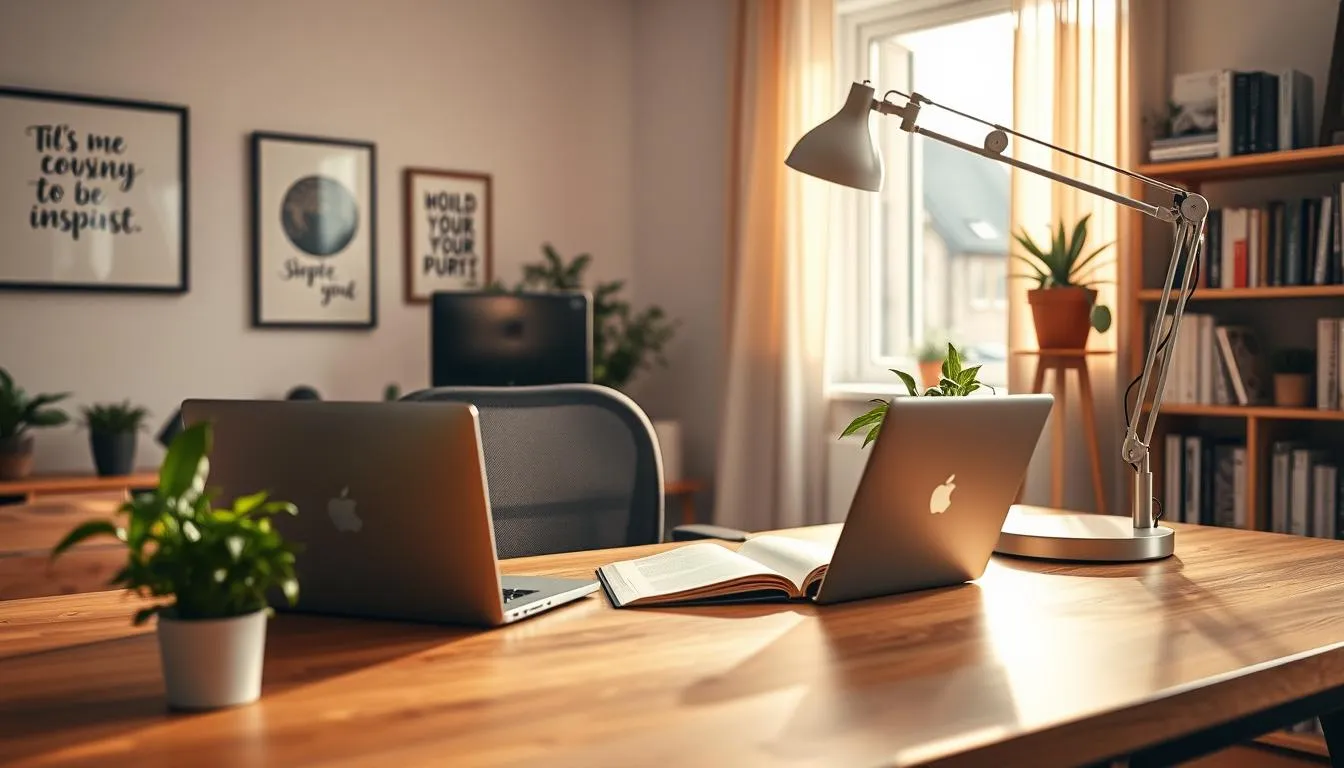
Layered lighting breaks a room into ambient, task, and accent zones. Ambient light provides even general illumination from overhead fixtures or chandeliers. Task light focuses on work areas with pendants, desk lamps or adjustable arm lights. Accent light adds depth with picture lights or small spot fixtures that highlight shelves and dcor.
Using layered lighting lets you control brightness where you need it most. A pendant over a desk opens the space and clears clutter. A sconce beside shelving creates transition paths and reduces eye strain when you shift focus from screen to paper.
Color temperature and CRI shape how colors and skin tones look on camera and in person. Choose LEDs with high color temperature CRI for accurate rendering. Brands such as Philips and Soraa offer high-CRI options and tunable white systems that adapt from warm to cool as tasks change.
Warm light suits relaxed calls and background accents. Cooler light boosts alertness for focused tasks. Picking fixtures with CRI 90+ yields more natural skin tones and clearer detail during design, reading or video work.
Glare control and placement are essential to reduce reflections on monitors. Position desk lamps to the side, use shades and diffusers, and select fixtures with glare-controlled optics. Many office luminaires meet UGR
LED strips and tunable white panels spread light evenly without hotspots. Motion and daylight sensors maintain consistent illuminance, cutting contrast that causes reflections. Aim lights slightly behind or above your monitor to minimize direct bounce into the screen.
For many remote workers, combining these strategies produces the best lighting solutions. Layered lighting, careful attention to color temperature CRI and glare control work together to support focus and comfort in small and large home offices alike.
innovative office lighting: modern technologies transforming remote work
Smart lighting is changing how people set up home offices. New systems focus on comfort, energy savings, and visual accuracy so remote workers can feel alert and look their best on video calls.
LED and Solid-State Lighting advantages for energy and longevity
LED advantages show up in lower energy bills and far longer lifespans than legacy bulbs. Manufacturers such as LEDVANCE and LBX Lighting highlight durability and reduced maintenance with solid-state lighting that still delivers high lumen output.
Commercial-grade LEDs resist shock and heat. Offices gain predictable maintenance cycles and consistent color over years, which helps companies save time and money on replacements.
Dynamic and tunable white systems for circadian support
Tunable white technology lets users shift color temperature across the day to match natural light. Systems like BIOLUX HCL and tunable white strips simulate daylight arcs to support circadian rhythms and boost daytime alertness.
Profiles can be automated for morning focus, midday clarity, and evening wind-down. Many modern controllers tie schedules to user routines so lighting changes happen without manual adjustments.
Quantum dot and emerging technologies improving color accuracy
Quantum dot lighting improves color rendering while keeping efficiency high. This tech boosts visual clarity for design work, accurate skin tones on video, and true color perception for detailed tasks.
Emerging options such as laser diodes promise still greater efficiency and compact fixtures. Integrating quantum dot lighting with smart controls gives remote workers a palette that feels more natural than older LEDs.
Small investments in advanced systems can yield better mood, fewer headaches, and stronger performance at work. Read an industry perspective on office lighting and productivity in this analysis.
Smart lighting systems and controls for a flexible remote workspace
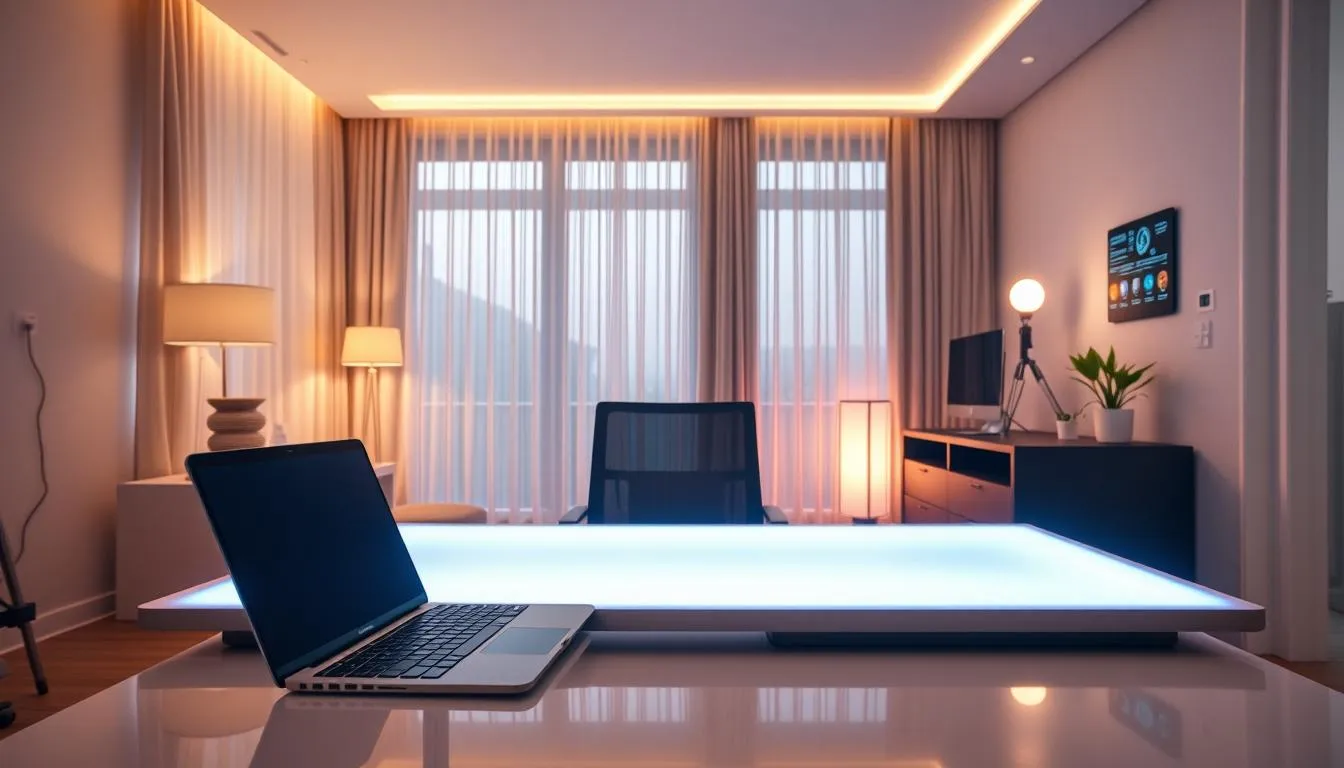
Creating a flexible home office starts with choices that match daily routines. Smart lighting systems let you shape light for focused work, meetings, and rest. App-driven options make setup quick. Voice assistants make hands-free changes simple.
The right app control lighting lets you store lighting scenes for remote work. You can create presets for deep focus, video calls, or short breaks. Brands such as Philips and LEDVANCE offer app-based commissioning and cloud backups for project data.
App and voice control: setting scenes for focus, meetings, and breaks
Use an app to save a few go-to scenes and recall them with one tap. A meeting scene can raise front-fill light and soften background accents. A focus scene can boost task lighting while lowering ambient glare.
Voice control adds speed when your hands are full. Combine app control lighting with smart speakers to switch scenes or trigger a break mode. That mix supports comfort and on-camera professionalism.
Schedules, automation, and geofencing to save energy and simplify routines
Lighting automation removes guesswork. Schedule lights to match work hours and to dim when you stop for the day. Geofencing wakes your desk lamp as you arrive home, then powers down after you leave.
Smart schedules cut bills and reduce maintenance. Systems that offer OTA updates and cloud monitoring help keep settings current without climbing a ladder.
Integration with IoT devices and home office ecosystems
IoT lighting integration links lights with sensors, HVAC, and calendars. Occupancy sensors can dim unused zones. Temperature and humidity data feeds into building automation for healthier conditions.
Open platforms and APIs make it easier to connect lamps, switches, and sensors. For a scalable, managed solution with energy dashboards and remote upkeep, see Interact Pro via Interact Pro.
| Feature | What it delivers | Why it matters for remote work |
|---|---|---|
| --- | --- | --- |
| App control lighting | Quick commissioning, scene storage, cloud backup | Fast setup, consistent lighting scenes for remote work, multi-user access |
| Lighting automation | Schedules, geofencing, OTA updates | Energy savings, routine simplification, fewer manual adjustments |
| IoT lighting integration | Sensor data, BACnet/KNX links, environmental monitoring | Better comfort, smarter HVAC interaction, space utilization insights |
| Scalability & compatibility | Zigbee, DALI, wireless sensors, wired options | Easy upgrades, retrofit-friendly, supports growth and renovation |
| Energy & maintenance tools | Dashboards, device health reports, remote troubleshooting | Lower operational costs, proactive upkeep, improved uptime |
Designing a home office that supports health and productivity goes beyond fixtures. Human-centric lighting helps align indoor illumination with daily biological needs. Small changes to light timing, color, and intensity can make long hours at a desk easier on the body and mind.
Mimicking daylight cycles with tunable white and BIOLUX-style profiles
Use tunable white profiles to recreate natural shifts from cool morning light to warm evening tones. Systems like BIOLUX HCL offer preset scenes that map color temperature and illuminance to phases of the day. These profiles help the body sense morning wake time, sustain mid-day focus, and prepare for winding down.
Using light intensity and temperature to boost alertness during work hours
Raise illuminance and shift to cooler temperatures for demanding tasks. Boost alertness lighting with bright, blue-enriched white during mid-morning and early afternoon to sharpen reaction time and focus. Lower intensity and warmer tones for breaks and meetings to reduce eye strain and maintain comfort.
Designing lighting for low-daylight rooms and night-shift schedules
Lighting for low-daylight rooms needs layered solutions that mimic outdoor cues. Combine overhead tunable white with task lamps and timed scenes to simulate daylight exposure. For night-shift schedules, program cooler, brighter phases when alertness is required, and gradual warm-down periods before sleep.
Below is a compact comparison to guide implementation choices for different room types and schedules.
| Goal | Recommended Approach | Example System |
|---|---|---|
| --- | --- | --- |
| Morning wake-up | Gradual increase in intensity with cool-white tunable white profiles | BIOLUX HCL morning scene |
| Midday focus | High illuminance, cool color temperature to boost alertness lighting | LED panels with tunable white profiles |
| Evening wind-down | Warm, low-intensity light to support melatonin production | App-controlled warm scenes |
| Low-daylight rooms | Layered lighting, commissioning via smartphone, circadian-aligned schedules | BIOLUX HCL single-room commissioning |
| Night-shift workflows | Timed bright phases during work, gradual warm-down before sleep | Dynamic tunable white systems |
Task lighting solutions: best lighting solutions for focused work
Good task lighting helps you see details, cut glare, and save energy during long workdays. Start by lowering harsh ambient light and adding a focused fixture that you can move. That approach improves contrast on documents and reduces reflections on screens while using fewer watts overall.
Desk lamps and pendant options that free up workspace
Desk lamps for remote work come in many styles. Choose a low-profile arm lamp when surface area is limited. Ceiling pendants and swagged pendant task lights free desk space and add layered illumination for the room.
Color Cord Company recommends pendants or wall mounts to clear the desktop and suggests creative lamp designs when a tabletop fixture is necessary. Use a pendant for general task wash, then add a small adjustable lamp for fine-detail work.
Directional task lights vs. diffused desk fixtures
Directional lamps put light precisely where you need it. They are excellent for reading and detail work because they concentrate lumen output on the task plane. Diffused desk fixtures soften shadows and reduce contrast, which can be gentler for long sessions at a monitor.
LBX Lighting highlights customization in modern LEDs, letting you dial beam shape and output so a directional light doesn’t create hotspots. Pick a fixture with good shielding and an adjustable head to avoid glare on screens.
Choosing bulbs and lumen levels for common remote work tasks
Match lumen levels for home office tasks to the activity: 200500 lux (2050 footcandles) for reading and paperwork, 50100 lux for ambient screen viewing, and 250450 lux for general office tasks. Use fixtures with CRI 90 for color-critical work and choose 3,3005,000 K LEDs when you need clear, neutral light.
LEDVANCE recommends UGR-controlled pendant luminaires and LED strips for even task illumination. Look for systems rated near 120 lm/W for efficiency and fixtures that integrate with DALI or Zigbee if you plan to scale controls.
For quick reference, consult a practical guide like this task lighting solutions when choosing fixtures and setting target illuminance.
| Task | Recommended lux | Fixture type | Notes |
|---|---|---|---|
| --- | --- | --- | --- |
| Reading printed documents | 200500 lux | Adjustable directional desk lamp | Use focused beam, CRI 90 for color accuracy |
| Computer work / mixed tasks | 50250 lux | Indirect ambient + pendant task lights | Lower ambient to reduce screen glare; add local task light |
| Sketching / detail design | 300750 lux | High-output directional fixture or LED strip | Higher lumen levels for fine visual tasks; consider tunable white |
| Video calls / front-fill | 200400 lux | Soft diffused desk fixture or ring light | Warm-neutral color (33004000 K) flatters skin tones |
Ceiling, wall, and space-saving fixtures to optimize small home offices
Small home offices need smart choices to stay tidy and functional. Pick fixtures that clear floors and desks while giving flexible light for focused work, video calls, and background ambiance.
Ceiling-mounted and wall-mounted fixtures to keep floors clear
Ceiling-mounted office lighting is ideal when square footage is tight. Panels, low-profile pendants, and flush mounts deliver wide, even light without taking floor space.
Wall sconces free up desk edges while adding layered illumination. Color Cord Company advises to keep it off the ground, favoring pendants and sconces to preserve usable areas.
Swag pendants and track lighting for flexible layouts
Swag pendants let you position light over a task without hardwiring. They free desk surface and allow quick changes in layout.
Track lighting from brands like LBX Lighting offers movable heads and contemporary styles. Tracks handle task and accent lighting in compact rooms while keeping a neat aesthetic.
Low-profile and recessed solutions for multi-use rooms
Recessed lighting for small offices keeps ceilings clean and unobtrusive. Use low-profile downlights or panel luminaires for rooms that double as guest spaces or hobby areas.
LEDVANCE recommends Zigbee-enabled panels, pendant direct/indirect luminaires, and LED strips for adaptable setups. Wireless controls and sensors make retrofits simple and avoid major rewiring.
Lighting for video conferencing and professional on-camera appearance
Good lighting makes you look awake, focused, and credible on every call. Start by facing a window when possible to use natural light. If a window isn’t an option, layer artificial light to mimic daylight and avoid flat, shadowed faces.
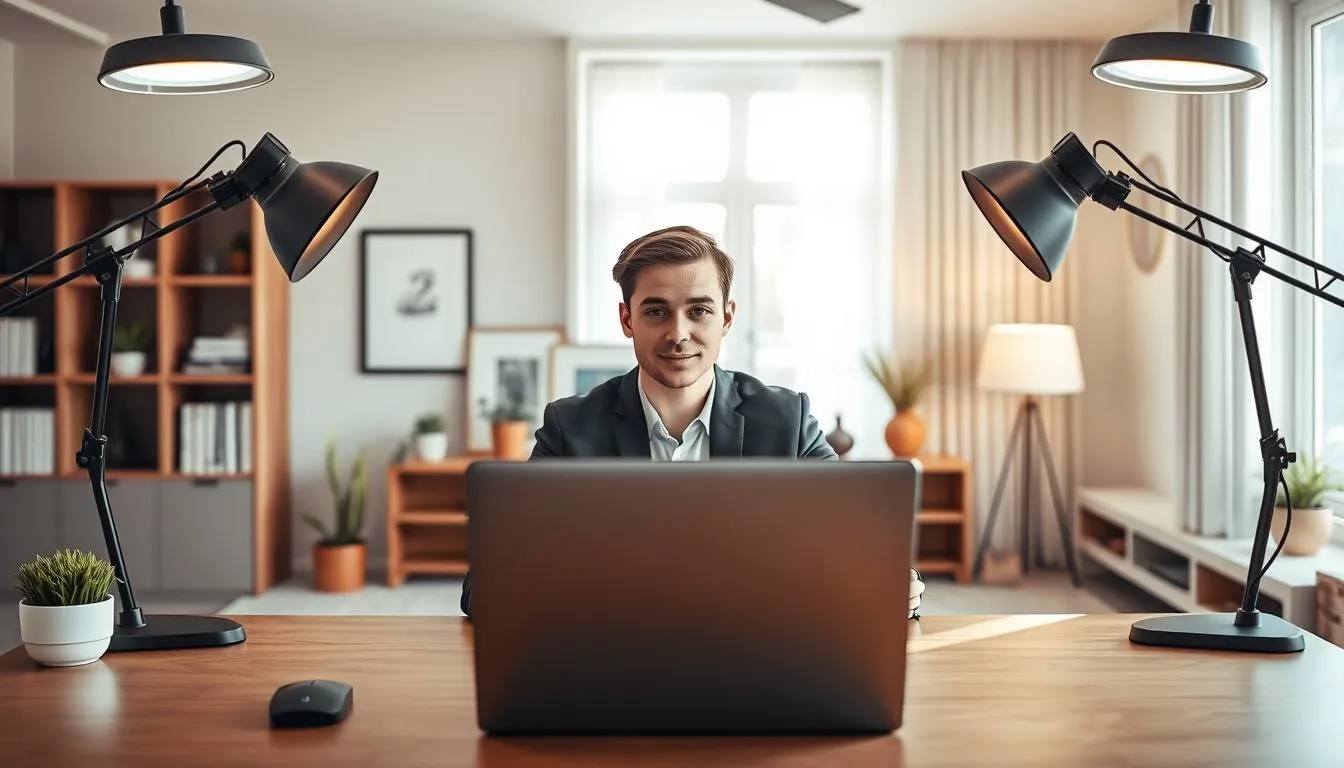
Raise your camera to eye level and place a soft, diffuse key light behind the webcam. Use front-fill lights to soften shadows and keep eyes bright. Aim for even, UGR-controlled illumination so reflections on glasses and screens stay minimal.
Positioning to face natural light or supplement with front-fill lights
Face natural light whenever the sun is flattering. If that light is too strong, add a diffuser or sheer curtain. Indoor setups benefit from a balanced trio: a key light, a gentle fill, and a subtle backlight to separate you from the background.
Front-fill lights should be close to the camera axis and set to low to medium intensity. LED panels from retailers like LEDVANCE or small ring lights work well when tuned to the right temperature.
Warm vs. cool tones for skin-flattering on-camera light
Choose color temperature with skin tones in mind. Warmer tones (22003000 K) flatter warm complexions and reduce pallor. Cooler tones (35005000 K) can look crisp on cooler skin tones but risk a clinical feel if overused.
Use tunable white systems from brands such as LBX Lighting or BIOLUX profiles to switch scenes. Set warmer shades for relaxed calls and neutral-cool for formal presentations to match the mood and maintain a professional look.
Background lighting and accent fixtures to create a polished backdrop
Background accent lighting helps craft a tidy, intentional backdrop. Add sconces, a pendant, or a small LED strip behind shelving to create depth. Accent lights highlight art or plants and steer attention toward you, not clutter.
| Goal | Recommended Fixture | Color Temp | Placement |
|---|---|---|---|
| --- | --- | --- | --- |
| Natural, flattering face light | Window or large softbox | 35004500 K | Directly facing subject, diffused |
| Shadow reduction | Front-fill lights (LED panel or ring) | 30004000 K | Near camera, slightly below eye level |
| Background polish | Pendant, sconce, or LED strip | 22003000 K for warmth | Behind subject, aimed at wall or dcor |
| Professional scenes | Tunable white/tunable LED system | 22006500 K adjustable | Whole room, set scenes via app |
Choose upgrades that pay back fast. Swapping out old bulbs for LEDs for home office use cuts energy use and lowers bills. LED technology gives bright, consistent light with less heat. That makes workspaces more comfortable while driving lighting cost savings.
Pick fixtures rated for high efficacy. Panel luminaires and high-efficiency downlights deliver more lumens per watt, so you need fewer fixtures to meet task needs. Long-life fixtures reduce replacement frequency, trimming maintenance time and waste.
Why LEDs and SSL reduce bills and maintenance
LEDs and solid-state lighting (SSL) use far less electricity than incandescent sources. Industry data shows LEDs can use up to 75% less energy, which translates to immediate savings on monthly statements. The longer service life of LEDs means fewer trips up ladders and fewer purchases over time.
Using sensors, timers, and smart scheduling to cut energy use
Install occupancy sensors and daylight controls so lights run only when needed. Motion sensors in entryways and timers in seldom-used rooms stop waste automatically. Smart scheduling and remote control let you lower power draw during breaks or outside work hours, boosting lighting cost savings further.
Selecting fixtures with long lifespans and recyclable materials
Look for products with modular designs and replaceable drivers or lenses. Brands such as LEDVANCE publish system numbers like lumens per watt to help compare options. Choosing recyclable housings and durable components extends service life and reduces landfill impact.
For budget-friendly transformation ideas, consult resources that highlight simple upgrades and quality fixtures to avoid repeated replacements. A short guide can help you weigh upfront cost against lifetime savings and predicted maintenance needs: sustainable office lighting ideas.
Combine efficient lighting with control technologies for the best results. Using sensors and timers for energy savings together with LEDs for home office setups and long-life fixtures creates a low-maintenance, low-cost workspace that supports comfort and productivity.
Upgrading existing spaces without major rewiring
Older homes and rented apartments can gain modern lighting features without tearing out walls. Choosing retrofit-friendly fixtures and plug-in options lets you upgrade lighting without rewiring and keeps installation simple. Small changes make a big difference for comfort and on-camera presence in a home workspace.
LBX Lighting and Color Cord Company show how to add smart control with minimal disruption. A Zigbee lighting retrofit can wirelessly link lamps and switches, while smart bulbs for home office use bring tunable white and scheduling to a single desk lamp. These steps avoid messy construction and preserve historic interiors.
VIVARES by LEDVANCE is built for modernization without rewiring. Zigbee 3.0 supports wireless commissioning and reconfiguration, so installers can add networked control to existing luminaires. SMART+ lamps and SMART+ Plug turn ordinary fixtures into connected points of control for light scenes and power monitoring.
Cloud-managed lighting platforms make off-site oversight possible. VIVARES Cloud provides energy and maintenance reports plus predictive diagnostics. Cloud-managed lighting helps facility managers track lamp life, spot faults early, and plan replacements without visiting each site.
For DIY and professional retrofits, follow a simple checklist:
- Confirm outlet locations and use plug-in pendants or shade-ready fixtures to reach power without new wiring.
- Test Zigbee lighting retrofit components for mesh coverage before final mounting.
- Choose smart bulbs for home office tasks that offer tunable color and adequate lumens.
- Pair devices with a cloud-managed lighting service to access usage data and alerts.
Use the comparison below to pick the right path based on skill level, budget, and desired features.
| Approach | Skill Needed | Typical Cost Range | Best For |
|---|---|---|---|
| --- | --- | --- | --- |
| Plug-in pendants and shade-ready fixtures | Low simple plug-in setup | $25$150 per fixture | Renters, historic homes, quick style updates |
| Smart bulbs for home office | Low screw-in and app setup | $15$60 per bulb | Tunable color, scenes, video calls |
| Zigbee lighting retrofit (mesh network) | Medium networking and pairing | $50$200 per room | Whole-room control, reliable wireless commissioning |
| Cloud-managed lighting systems | Medium to High system setup and integration | $200+ for gateway plus subscription | Remote management, energy tracking, predictive maintenance |
Create a warm, productive room by treating light as a core design choice. Start with a clear plan that mixes practical task light with decorative choices. Good planning helps a small desk feel curated and a larger office feel cohesive.
Use pendants and sconces to frame work zones and add height to the room. A pendant over the desk gives focused task light while a wall sconce provides soft fill. Select shadesglass, metal, or natural fiberto change glare and mood.
Choose custom fixtures color cord to match trim, upholstery, or artwork. Color Cord Company offers long plug-in cords and a range of shades that make mixing materials simple. Custom wiring and plug-in options let you add style without rewiring.
Think about scenes you can call up for different activities. LBX Lighting highlights how smart scenes let you shift from focused work to relaxed reading with one tap. Programmed scenes protect your eyes and set the right tone for client calls.
Accent lighting ideas include picture lights, LED strips, and directional mini-spot fixtures. Use them to highlight shelves, plants, or framed art so the room reads as intentional. Accent pieces reduce visual monotony and draw attention to focal points.
Consider modular luminaires and LED strips to create clean architectural lines. LEDVANCE and other brands offer assemble-to-order systems that blend decorative form with even illumination. Those tools help craft an inviting remote workspace with a polished look.
Balance color temperature across fixtures so skin tones look natural on video. Use warmer pendants and neutral task lights together to keep the scene flattering. Test placement to avoid screen glare while maintaining attractive background layers.
Finally, mix finish and scale for personality. Pair a matte black pendant with brass sconces or use woven shades with slim LED channels. Thoughtful contrasts make the space feel layered, personal, and ready for focused work.
Safety, air quality, and advanced features to future-proof your home office
Designing a safe, healthy workspace means thinking beyond fixtures. Start by improving home office air quality with quiet, non-chemical systems and air-disinfection options that fit above desks or in shared rooms. Pair clean-air devices with thoughtful lighting to support comfort and long-term wellbeing.
UV-C air disinfection integrations and non-chemical air safety options
UV-C air disinfection units from trusted manufacturers such as LEDVANCE can reduce viral and bacterial load without filters or chemicals. These devices run quietly, have long lamp life near 16,000 hours, and suit small to mid-size home offices.
Combine a UV-C device with routine ventilation, HEPA filtration where needed, and smart scheduling so the system runs when rooms are occupied. For cloud-based control and reporting, check interoperable offerings that connect to building or home systems via standard protocols and apps like the ones available from Interact.
Lighting solutions that minimize flicker and improve long-term comfort
Low-flicker lighting matters for eye comfort and reduced fatigue during long workdays. Choose certified low-flicker downlights and strips for task areas and ambient zones.
Use color temperature tuning to follow natural rhythms. BIOLUX-style controls and adaptive dimming let you match light intensity for video calls, deep focus, or winding down. These steps cut glare and help sustain attention without adding visual strain.
Planning for scalability: modular and assemble-to-order fixtures
Modular lighting fixtures simplify upgrades and add functionality as needs change. Assemble-to-order luminaires let you swap sensors, controls, or optics rather than replace entire fittings.
Opt for systems that support occupancy sensing, daylight harvesting, and BACnet or cloud integration. Those options create a foundation for predictive maintenance, energy reporting, and demand-response participation.
| Feature | Benefit | Practical note |
|---|---|---|
| --- | --- | --- |
| UV-C air disinfection | Reduces airborne pathogens without chemicals | Choose quiet units with long lamp life; install per manufacturer guidance |
| Low-flicker lighting | Improves comfort and reduces eye strain | Select products tested for flicker and pair with dimming controls |
| Modular lighting fixtures | Enables easy upgrades and customization | Look for assemble-to-order options and luminaire-integrated sensors |
| Smart sensors and controls | Deep energy savings and occupant comfort | Use occupancy sensing, daylight harvesting, and app commissioning |
| Cloud and BMS integration | Remote monitoring, reporting, and firmware updates | Prefer BACnet compatibility and secure OTA updates |
Conclusion
Quality, layered lighting and well-chosen fixturespendants, sconces, and task lampscreate an inviting room that supports focus and improves video-call presence. Personal touches like color cords and shades make the space feel tailored, boosting satisfaction while keeping clutter low. These design choices are core to lighting for remote work and enhancing remote workspace comfort.
Modern technologies deliver on both performance and efficiency. LEDs, dynamic controls, and smart integration provide energy savings and flexible scenes for focus, meetings, and breaks. Choosing the best lighting solutions means balancing form and function so the system adapts as work patterns change.
Products such as LEDVANCE VIVARES Zigbee/DALI, BIOLUX human-centric lighting, UV-C options, and cloud management show how tunable, wireless, and retrofit-friendly systems future-proof home office setups. Combining human-centric design with smart controls helps productivity, supports well-being, and lowers long-term costsmaking innovative office lighting a practical investment for a future-proof home office.
FAQ
What lighting types make a home office more productive and comfortable?
Layered lightingambient (overhead chandeliers or panels), task (desk lamps, pendants over work zones), and accent (picture lights, wall sconces)creates a multi-dimensional environment that improves focus and comfort. Combine natural daylight with LED task lights and low-glare accent fixtures to reduce eye strain and make the room feel inviting. Ceiling- and wall-mounted fixtures free floor and desk space while improving room flow.
How does color temperature affect my focus and on-camera appearance?
Color temperature matters for both performance and video calls. Cooler whites (around midday) support alertness and concentration, while warm whites (22002700 K) create flattering, camera-ready skin tones and a cozy atmosphere. Tunable white systems let you shift temperature through the day to mimic daylight cycles for better circadian support.
What is human-centric or circadian lighting, and is it worth it?
Human-centric lighting (HCL) uses tunable white and dynamic intensity to simulate daylight patternswarm in the morning, cooler at noon, warm again in the evening. Research and systems like BIOLUX HCL show benefits for sleep, alertness, reduced eye strain, and sustained productivity, especially in low-daylight rooms.
Which LED features should I look for to ensure good color and reduced eye strain?
Choose LEDs with high CRI (90+ when accurate skin tones or color work matters), low flicker, and glare-controlled optics (UGR
Can I upgrade my home office lighting without rewiring the space?
Yes. Plug-in pendants, shade-ready fixtures, smart bulbs, and wireless controls (Zigbee, Bluetooth, WiFi) enable upgrades with minimal wiring. Retrofit-friendly panel luminaires and smart plugs let you add dynamic control, scheduling, and app-based commissioning without major renovations.
How can smart lighting and controls improve my remote workday?
Smart lighting enables scenes, schedules, geofencing, and remote control so you can set focus, meeting, and break modes. Motion and daylight sensors preserve energy while maintaining proper illuminance. Cloud-managed systems offer energy dashboards and maintenance alerts for long-term savings.
What task lighting setups save desk space but still provide focused illumination?
Ceiling-mounted pendants and wall sconces keep it off the ground, freeing desk area. Swag pendants and low-profile suspended fixtures direct light where needed without cluttering surfaces. If a desk lamp is necessary, choose slender, directional fixtures that minimize footprint and glare.
How should I light for video conferencing to look professional on camera?
Face a window when possible to get soft, natural front light. If natural light is limited, use a front-fill light with warm bulbs (22002700 K) or tunable white set to flattering color. Control background lighting with accent fixtures and avoid overhead backlighting that creates harsh shadows or screen glare.
What energy-saving lighting options deliver the best long-term value?
LED and solid-state lighting deliver major savingsup to 75% lower energy use versus incandescent, longer lifespans, and reduced maintenance. Combine LEDs with sensors, timers, and smart scheduling to minimize runtime. Select fixtures rated for high efficacy (e.g., 100120 lm/W) and durable materials for recyclability.
How do I design lighting for a small or multi-use home office?
Use recessed or low-profile ceiling luminaires for general light, wall-mounted sconces to add depth, and track or swag pendants for flexible task zones. LED strips and tunable panels create uniform illumination without taking floor space, while modular fixtures let you adapt the layout as the rooms purpose changes.
Are there lighting solutions that improve air quality or safety in shared workspaces?
Some manufacturers offer UVC air disinfection units designed for quiet, low-maintenance operation that inactivate viruses and bacteria without chemical filters. Additionally, choose lowflicker luminaires and safe cable management to reduce hazards and long-term discomfort.
What practical tips help me personalize lighting while staying on budget?
Start with quality, plug-in fixtures like pendant lights and shade-ready options to create a distinct look without installation costs. Use color cord, glass or natural-fiber shades, and accent picture lights to add personality. Prioritize durable bulbs and energyefficient LEDs to avoid frequent replacements and save money over time.